
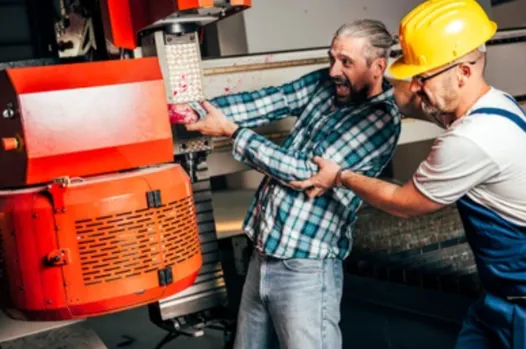
Quick Answer
Machine shops combine several high-risk exposures in one workplace: cutting and rotating equipment, pinch points, stored energy, metal chips, welding or grinding, chemicals, noise, heavy material handling, and repetitive motion. California safety rules require guarding of hazardous moving machinery, energy-control procedures for many servicing tasks, hazard communication for workplace chemicals, and appropriate personal protective equipment. If a machine-shop worker is injured, the workers’ compensation claim should document not only the diagnosis but also the machine, task, energy state, guard condition, material, chemical, noise exposure, witnesses, and how the event was reported.
A machine shop is not dangerous simply because it contains industrial equipment. Risk depends on what the worker is asked to do, how the machine is guarded, whether hazardous energy is controlled, what materials are processed, whether noise and chemicals are managed, and whether the worker has the training and protective equipment needed for the task.
For an injured worker, the practical question is not “was this a dangerous machine shop?” It is: what happened, what exposure caused the injury, what evidence still exists, and what benefits or safety processes may apply?
Machine guarding: the first line between the worker and the hazard
California General Industry Safety Orders require guarding of hazardous moving machine parts and points of operation in covered circumstances.
Title 8 section 4002 requires guarding of hazardous moving parts that create revolving, reciprocating, running, shearing, punching, pressing, squeezing, drawing, cutting, rolling, mixing, pinch-point, or shear-point hazards when those hazards are not otherwise guarded by the machine frame or location.
Section 4184 separately addresses point-of-operation guarding for machines with actions such as grinding, shearing, punching, pressing, squeezing, drawing, cutting, rolling, or mixing when employees can enter the danger zone.
For workers, the important point is that a missing, defeated, moved, or inadequate guard can matter both to immediate safety and to the evidence surrounding an injury.
If an incident involves a guard, document—without placing yourself in danger—whether the guard was present, where it was positioned, whether it had been removed for the task, and whether the machine was altered after the event.
Lockout/tagout and unexpected startup
Some of the most severe machine-shop injuries happen during cleaning, servicing, adjustments, setup, or clearing jams—when a worker may be closer to hazardous machine parts than during ordinary production.
California Title 8 section 3314 addresses control of hazardous energy for cleaning, repairing, servicing, setting up, and adjusting machinery and equipment where unexpected energization, startup, or release of stored energy could cause injury.
The rule generally requires machinery capable of movement to be stopped and the power source de-energized or disengaged during covered operations, with additional lockout/tagout or other controls depending on the task and equipment.
This matters after an injury because the central question may not be “did the operator press the wrong button?” It may be whether the machine had actually been isolated from electrical, mechanical, hydraulic, pneumatic, thermal, chemical, or stored energy before the work began.
Common machine-shop injury patterns
Cuts, amputations, crush and caught-in injuries
Lathes, mills, presses, saws, grinders, drills, rollers, and other powered equipment can create cutting, crushing, entanglement, pinch-point, and amputation hazards. Loose clothing, gloves used in the wrong context, jewelry, hair, workpieces, rotating stock, chucks, and unguarded components can increase danger.
After an incident, identify the exact machine and operation. “Injured on a machine” is not enough detail for a medical history or claim investigation.
Eye and face injuries
Grinding, cutting, drilling, milling, welding, and compressed-air use can send chips, fragments, sparks, or fluids toward the face. California’s PPE rules require employers to assure that required protective devices—including eye, face, head, hand, foot, limb, clothing, respiratory, shield, or barrier protection—comply with applicable standards and are maintained appropriately.
An eye injury should receive prompt medical evaluation. Metal fragments and chemical exposures can cause serious damage even when pain initially seems manageable.
Burns and welding-related injuries
Machine shops may involve hot metal, welding, brazing, cutting, sparks, heated surfaces, and flammable materials. Burn injuries can range from superficial contact burns to severe thermal or electrical injuries.
When documenting the event, record whether the injury involved open flame, hot metal, electricity, chemical contact, or an explosion because the mechanism affects both treatment and investigation.
Chemical exposure
Cutting fluids, degreasers, solvents, coatings, adhesives, cleaners, metalworking fluids, and other products may create skin, eye, respiratory, or systemic hazards.
California’s Hazard Communication standard, Title 8 section 5194, requires covered employers to maintain a written hazard communication program and provide information and training about hazardous workplace chemicals, including labels and safety data sheets.
If a chemical exposure occurs, preserve the product name, container label, safety data sheet, and any information about ventilation or protective equipment. The exact chemical identity can be far more useful than simply writing “solvent exposure” in a medical record.
Hearing loss and tinnitus
Machine shops can be loud enough to create long-term hearing risk. California’s hearing-conservation standard applies in covered general-industry workplaces when employee noise exposure equals or exceeds an 8-hour time-weighted average of 85 dBA.
Noise exposure is not limited to one machine. Multiple tools, impact operations, compressed air, grinding, cutting, and nearby equipment can combine across the shift.
For information about work-related hearing changes and workers’ compensation claims, see Occupational Hearing Loss Guide.
Repetitive strain and cumulative trauma
Not every machine-shop injury happens in one moment. Repeated gripping, awkward posture, forceful exertion, material handling, vibration, and repeated tool use can contribute to musculoskeletal symptoms over time.
The absence of one dramatic accident does not automatically make a condition non-industrial. California workers’ compensation recognizes both specific injuries and injuries or illnesses that develop through repeated work exposure, subject to medical and legal proof.
Document when symptoms began, which tasks aggravated them, how often the tasks were performed, and whether the problem changed when duties changed.
Back, shoulder and lifting injuries
Machine-shop work often includes moving stock, fixtures, finished parts, tools, containers, and scrap. Even when a hoist or cart is available, positioning and repetitive handling can strain the back, shoulder, knee, or other body parts.
For a lifting injury, note the approximate weight, shape, lift height, twisting or reaching involved, assistance available, and whether the event was sudden or cumulative.
What should you do immediately after a machine-shop injury?
Get medical care
For severe bleeding, amputation, crushing, eye penetration, electrical injury, significant burns, loss of consciousness, breathing difficulty, or other emergencies, emergency care comes first.
Tell medical providers that the injury happened at work and describe the machine or exposure accurately.
Report the injury promptly
California DWC advises workers to notify the employer as soon as possible and warns that failing to report within 30 days can jeopardize benefits. For gradually developing injuries, report when you learn or believe the condition is caused by the job.
Obtain and file the DWC-1 claim form
DWC states that an employer must provide or mail a claim form within one working day after learning of the injury or illness. Complete the employee section, sign and date it, return it to the employer, and keep a copy.
Preserve the machine and task evidence
Useful evidence may include:
- machine make/model or asset number;
- exact operation being performed;
- guard condition;
- lockout/tagout status;
- emergency-stop use;
- workpiece and material involved;
- photographs if safe and lawful;
- product labels and safety data sheets;
- witness names;
- training records you received;
- maintenance or repair activity occurring nearby; and
- work-status notes after treatment.
Do not interfere with an investigation or enter a hazardous area to collect evidence.
What benefits can workers’ compensation provide?
Depending on the claim and medical evidence, California workers’ compensation may provide:
- reasonably necessary medical treatment;
- temporary disability payments when qualifying wage loss occurs during recovery;
- permanent disability benefits for lasting impairment;
- supplemental job displacement benefits in qualifying cases where permanent partial disability exists and the worker is not offered qualifying work; and
- death benefits for qualifying dependents after a fatal work injury.
Workers’ compensation is generally a no-fault system. A worker ordinarily does not need to prove the employer was negligent to seek covered benefits. That does not mean every claim is automatically accepted; disputes can still arise over whether the condition is industrial, the extent of injury, medical treatment, disability, or other issues.
What if a third party or defective machine contributed?
Some machine-shop incidents may involve a company other than the injured worker’s employer—for example, an outside maintenance contractor, property entity, equipment supplier, or manufacturer. Workers’ compensation and third-party liability are different legal systems and may coexist in some circumstances.
Do not assume a separate claim exists simply because a machine failed. Preserve identifying information about the machine and outside entities so the issue can be evaluated later.
Should an unsafe machine condition be reported to Cal/OSHA?
Workers can report workplace safety concerns to Cal/OSHA. A safety complaint focuses on unsafe conditions and regulatory enforcement; a workers’ compensation claim focuses on benefits for the injured worker. They are separate processes.
If the hazard continues to expose workers after an incident, documenting and reporting the condition can serve a different purpose than pursuing the workers’ compensation claim.
A better evidence checklist for machine-shop cases
Event evidence
- machine and task;
- date/time/shift;
- guard position;
- energy-control status;
- alarm or emergency stop;
- supervisor instructions; and
- witnesses.
Exposure evidence
- chemical/product name;
- safety data sheet;
- noise source;
- PPE used;
- ventilation or extraction system; and
- repeated task frequency.
Medical evidence
- emergency records;
- diagnoses;
- imaging;
- work-status notes;
- referrals; and
- symptom history for cumulative injuries.
Claim evidence
- DWC-1 form;
- employer’s completed copy;
- claims administrator letters;
- benefit notices;
- job offers; and
- disputed treatment or disability decisions.
Bottom Line
Machine-shop injuries are rarely explained by one generic label such as “machinery accident.” The useful record identifies the exact machine, operation, guard, energy state, material, chemical or noise exposure, medical injury, and reporting timeline. California safety rules address guarding, hazardous energy, chemicals, PPE and noise, while workers’ compensation addresses medical care and other benefits for qualifying job injuries. Preserve the physical and documentary evidence early because the workplace can change quickly after an incident.
Frequently asked questions
What are the most common machine-shop injury hazards?
Common categories include moving machinery, pinch/caught-in hazards, cuts, eye injuries, burns, hazardous energy during servicing, chemical exposure, hearing loss, repetitive strain, and material-handling injuries. The actual risk depends on the task and controls.
Does workers’ comp cover an injury if I made a mistake?
California workers’ compensation is generally no-fault, so negligence is not usually the deciding issue for basic coverage. Eligibility still depends on whether the injury arose out of and occurred in the course of employment and on other claim facts.
What if the machine guard had been removed?
Document the condition if it can be done safely and lawfully. Guarding may be relevant to a safety investigation and to understanding how the injury occurred.
Can gradual hand or shoulder pain be a workers’ comp injury?
Potentially. Repetitive or cumulative work exposures can support a claim when the medical and factual evidence connects the condition to work.
What if loud machinery damaged my hearing?
See Occupational Hearing Loss Guide for a focused guide on occupational hearing loss, audiograms, evidence, and claim steps.
Sources and Legal References
- https://www.dir.ca.gov/title8/4002.html
- https://www.dir.ca.gov/Title8/4184.html
- https://www.dir.ca.gov/Title8/3314.html
- https://www.dir.ca.gov/title8/5194.html
- https://www.dir.ca.gov/title8/3380.html
- https://www.dir.ca.gov/title8/5097.html
- https://www.dir.ca.gov/dwc/InjuredWorker.htm
- https://dir.ca.gov/dwc/FileAClaim.htm
- https://www.dir.ca.gov/dwc/workerscompensationbenefits.htm
Related legal resources: Workplace Machinery Injury Lawyer; Workers’ Compensation Lawyer in Van Nuys.
This article provides general California legal and workplace-safety information and is not individualized legal advice.